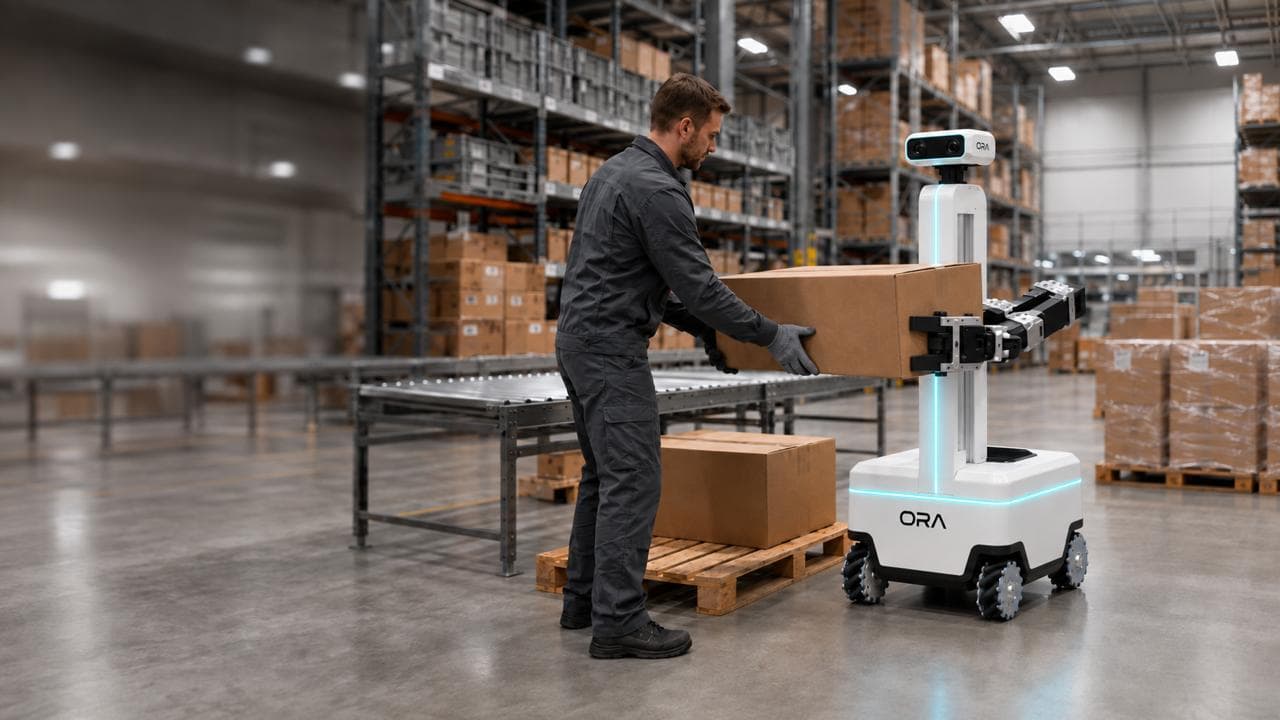
A robot that cannot see cannot act.
Layer Vision is the perception layer of our robot. It turns raw camera streams into an understanding of the scene, in real time, onboard, and it is built on a decade of computer vision running in production at XXII.
Every gesture starts with a look.
A robot arm can be precise to a tenth of a millimetre and still be useless. Without perception it does not know where the box is, that the box moved, that a person just stepped into its path, or that the part in front of it is the wrong one.
Manipulation is a closed loop: see, decide, move, see again. The quality of that loop is set by the quality of the seeing. Which is why we did not buy our perception, we built it.
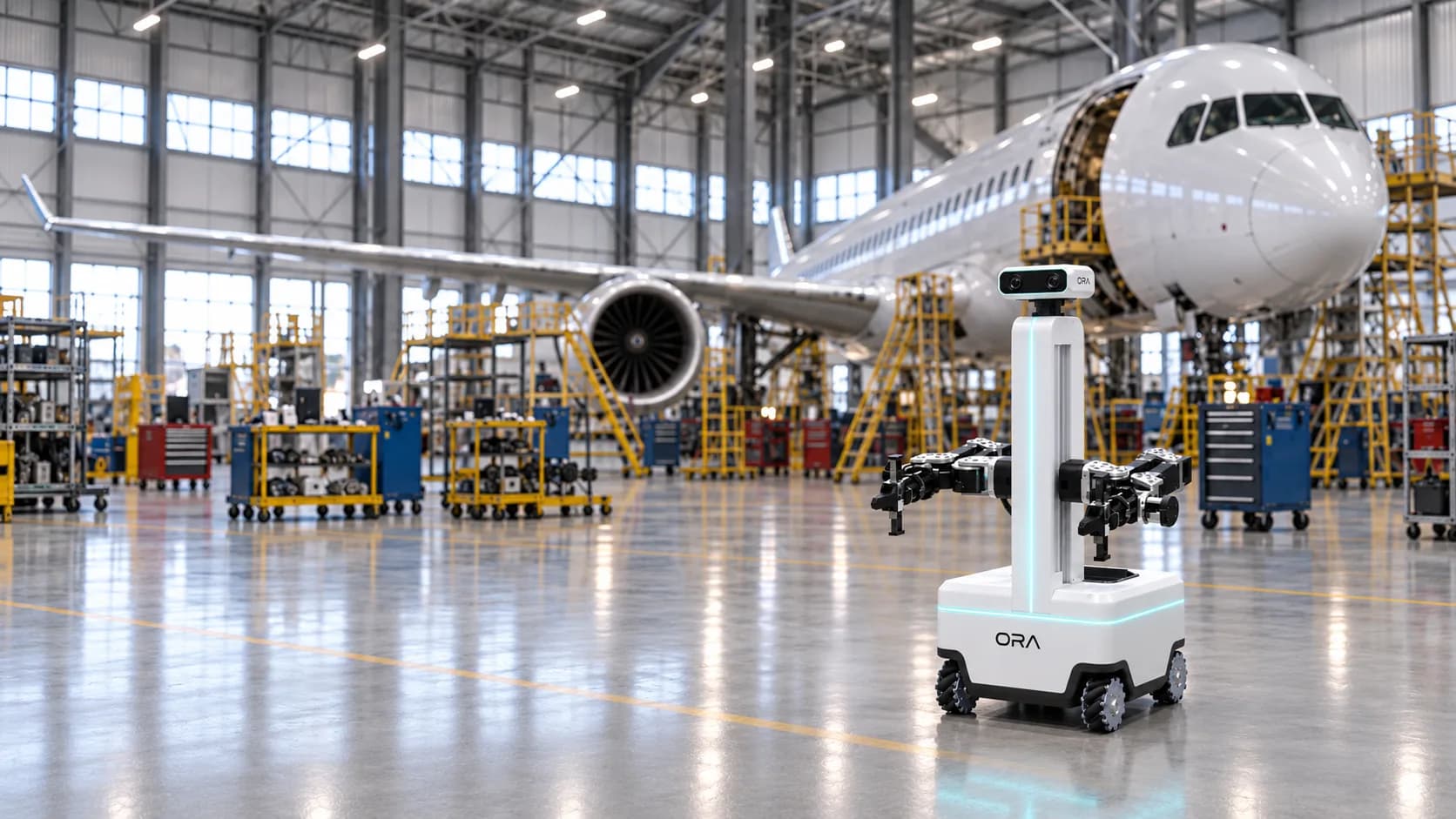
From pixels to an actionable scene.
Four layers run on every frame, from raw sensor input to the structured description the control policy consumes.
Detection
People, vehicles, containers, tools, parts. Which objects are in the frame, where, and how confident the model is about each one.
Tracking
Identity kept across frames, so a box that moves is the same box and a person walking past is one person, not thirty detections.
Spatial pose
Where things are in three dimensions relative to the robot, and how they are oriented, which is what turns a detection into something graspable.
Scene understanding
The relations that matter: what is on top of what, what blocks the path, what is out of place, what changed since the last pass.
If it needs the cloud, it is too slow.
A hand closing on a moving object has no time for a round trip to a data centre. Perception runs on the robot, on embedded compute, within a fixed latency budget.
Onboard inference
The full stack runs on embedded compute on the robot. No cloud dependency, no bandwidth cost, no outage risk.
Fixed latency budget
Perception is engineered around the control loop, not the other way round. Predictable timing is a safety requirement.
Degrades gracefully
Poor lighting, motion blur, partial occlusion. The engine reports uncertainty instead of guessing, and the robot slows down.
Sensor agnostic
Wrist cameras, 360° head, depth. Layer Vision fuses the streams rather than depending on one perfect sensor.
Not a research prototype. A decade in production at XXII.
Layer Vision did not start with the robot. It started years earlier at XXII, analysing live video in industrial and urban environments, where a false positive costs someone real money and a missed detection costs more than that. Robotics inherits an engine that has already been hardened by the field.
Computer vision in production
Built and shipped long before the robot existed, on live video streams in real operating conditions.
Hardened by deployment
Tuned against the failures that only appear on site: glare, dust, crowding, cameras nobody cleaned.
Ours, end to end
Models, pipeline and embedded runtime are our own, so we can change them the day the field asks for it.
A robot works among people. It does not surveil them.
Detecting a person to slow down and give way is a safety function, not an identification. Our perception is built so the two can never be confused, and so a site operator can prove it.
Perception is what makes a language instruction executable.
Vision Language Action models need something to ground language in. When an operator says take the grey bin on the second shelf, it is Layer Vision that decides which pixels are the grey bin, where it is in space, and whether the gripper can reach it. Same loop in reverse during capture: what the perception layer sees is what the dataset records.
Give your robots eyes that were built for the field.
Tell us about your environment, your sensors and your latency constraints. We will tell you what our perception layer can do on it.